
Endpoint management services help small and midsized organizations control security, productivity, and support costs across laptops, desktops, and mobile devices. Inconsistent device management leads to missed updates, weak security settings, unclear ownership, and unnecessary risk.
A right‑sized endpoint strategy focuses on visibility, standardized policies, proactive maintenance, and ongoing administration. When implemented well, endpoint management improves uptime, supports compliance, enhances employee experience, and provides leadership with clearer insight into technology risks and lifecycle planning.
One missed patch on a single laptop can turn into a company‑wide issue within days. Many small and midsized businesses face this risk because devices are spread across offices, homes, and job sites, while support still relies on manual checks and reactive fixes. Endpoint management services help close this gap by providing a structured way to secure, update, monitor, and support every business device without overwhelming internal staff.
Endpoint management is often viewed as routine IT upkeep. In reality, it is an operational control. Every laptop, desktop, tablet, and mobile device that accesses company data affects security, productivity, compliance, and support costs. When devices are managed inconsistently, small issues quietly build up—missed updates, uneven security settings, excess permissions, unknown software, and devices that no one fully tracks.
What endpoint management services actually do
Effective endpoint management combines tools, policies, and ongoing administration. The goal is not just visibility, but consistency.
Most services begin with reliable device inventory. Many organizations cannot quickly answer how many devices they own, who uses them, or whether they meet security standards. Without that baseline, risk and costs are harder to control.
From there, endpoint management typically includes patching, antivirus and endpoint protection, operating system updates, software deployment, configuration enforcement, encryption monitoring, access controls, and remote support. Some providers also handle mobile device management, onboarding and offboarding, warranty tracking, and reporting for leadership or auditors.
The real value lies in administration. Tools do not manage themselves. Someone must review alerts, handle exceptions, test updates, and keep standards aligned as staff and devices change.
Why SMBs struggle with device control
Most small organizations inherit fragmented environments as they grow. Devices are purchased over time, remote work is added quickly, and teams adopt different tools. Responsibility becomes split between office staff, consultants, and whoever is available when something breaks.
This works briefly, but it does not scale. Gaps appear, and accountability fades. A managed endpoint approach replaces that patchwork with consistent standards and a clear owner, reducing both support friction and risk.
Benefits beyond security
Security matters, but it is not the only return. Managed endpoints improve uptime through scheduled updates and monitoring. They reduce waste by tracking software usage and hardware lifecycles. They also improve employee experience by ensuring devices are configured predictably and supported efficiently.
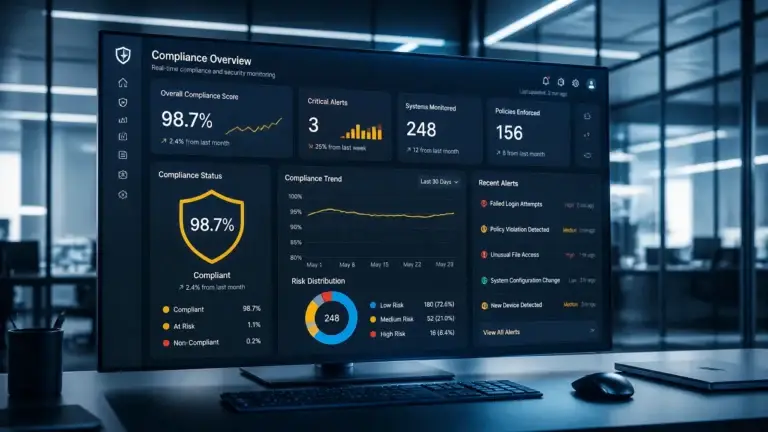
For regulated organizations and public‑sector teams, endpoint management provides documentation that supports audits, insurance reviews, and vendor requirements. It also gives leadership better insight into aging devices, recurring issues, and upcoming costs.
Choosing the right endpoint management partner
Not all providers take the same approach. Some focus mainly on tools. Others offer rigid packages that do not reflect real business needs.
A better fit starts with understanding how your organization operates, what systems are critical, what compliance expectations apply, and how much internal IT capacity exists. Vendor‑neutral guidance helps ensure recommendations are based on need, not product preference.
Clear responsibility is essential. Patch approvals, alert response, exceptions, and offboarding must be defined. A service that sounds comprehensive but is vague about ownership often creates problems later.
A sustainable endpoint strategy
There is no universal model. Fully managed services work well where internal IT capacity is limited. Co‑managed models can be effective when roles are clearly documented. Strong endpoint programs balance standardization with controlled exceptions for teams that need flexibility.
Endpoint management succeeds when treated as an ongoing discipline—not a one‑time cleanup. The best strategy is practical, sustainable, and aligned with how your business actually works. For SMBs, that matters more than any single platform feature.
Endpoint management is not just another IT service. It is a way to restore accountability, stability, and informed decision‑making across the devices your organization relies on every day.